Organizing a high-level congress, conference or convention is, in essence, a balancing act without a net. You have hundreds of in-person attendees, perhaps thousands connected via streaming, and a VIP speaker on stage who has flown in for six hours to give a twenty-minute talk. In that high-pressure ecosystem, “Murphy’s Law” is not a popular saying; it’s a real statistical threat.
What differentiates a professional event from a viral social media disaster is not luck, but redundancy. In technical parlance, redundancy is the duplication of critical components with the intention of increasing system reliability. For you, as an organizer, it means only one thing: sleeping soundly the night before the event.
Before you sign up with any supplier, you need to understand what to ask for. But first, let me tell you why this is vital.
The Silence of the 800 Attendees (The Anecdote)
A few years ago, I attended an international medical congress in Barcelona as a support technician. We were not the main suppliers, we only provided logistical support. The company in charge of audiovisual, seeking to maximize its profit margin, had decided to operate with just the right equipment: a single computer for presentations, a single projector and a single digital sound table.
At 11:30 AM, Dr. Strauss, an eminence in cardiology, took the podium. He was going to present a video of a revolutionary surgery. When he gave the “play” signal, the main computer (which had been running for 4 hours straight processing heavy graphics) froze. Blue screen.
The silence in the room was physical; you could chew. The technician, in a cold sweat, had to reboot the system. It was four minutes. Do you know how long four minutes is with 800 people staring at a black screen? An eternity. The doctor lost his rhythm, the audience pulled out their phones to tweet about the glitch, and the organizer’s reputation plummeted in real time.
The sad thing is that such a disaster cost very little to avoid. All it took was a second computer connected to a video switcher. One “click” and no one would have been the wiser. That’s the difference between hiring cheap and hiring security.
The Checklist: What to Demand from Your Supplier
To avoid being the protagonist of the previous anecdote, when requesting a quotation from an audiovisual company you should demand specific redundancy protocols. Do not assume they include them; ask.
Here are the critical points to shield:
1. Video Redundancy (The "Hot Backup" System)
Never, under any circumstances, should a corporate event be managed with a single video source.
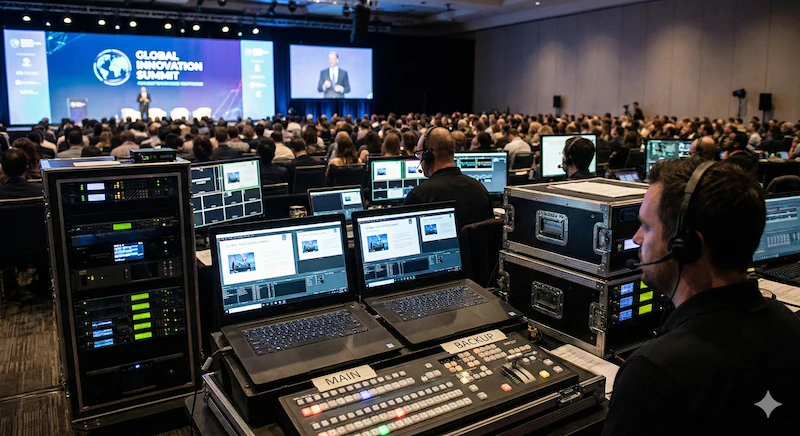
What you should ask for: Requires a Main and Backup system. This means two identical computers (Mac or high performance PC) running the presentation simultaneously. Both must enter a professional video switcher. If computer A fails, the technician presses a button and computer B takes over in less than a second (imperceptible blackout or fast dissolve).
The projector: In large auditoriums, dual projectors (stacking) are often used. If one lamp explodes, the other continues projecting and the image is not lost, only the brightness drops a little.
2. Audio Redundancy (The Analog Plan B)
Audio is the one thing that can’t go wrong. If the video goes, people listen; if the audio goes, the event is over.
Microphones: Radio frequencies can be saturated, especially in hotels full of people with cell phones. It requires that the lectern always has, in addition to wireless microphones, a gooseneck microphone with cable (wired backup). The cable does not understand interference.
The console: For critical events, a serious audiovisual company will carry a backup mixing console or, at least, a routing system that allows bypassing the digital console if it suffers a software blockage.
3. Streaming and Internet Redundancy (Bonding)
If your event is hybrid, the hotel’s internet is not enough of a guarantee. A fiber cut in the next street can leave you offline.
What you should ask for: A Bonding system. This is a device that aggregates several connections (e.g. the fiber of the venue + 3 4G/5G SIM cards from different operators). If the physical line goes down, the data automatically flows over the mobile networks without the viewer at home noticing a break in transmission. In addition, it requires local recording on camera and external hard drive, so that if the streaming fails catastrophically, you can upload the video later.
4. Electric Power (UPS)
The best equipment is useless if there is a micro power outage in the building.
-
The requirement: All control equipment (computers, video scalers, sound boards) must be connected to an Uninterruptible Power Supply (UPS or online UPS). This protects the equipment from voltage spikes and, if the power goes out, keeps everything on long enough for the venue’s generators to come in or to safely save and shut down.
The Final Decision: The Human Factor
Having duplicate teams is half of the equation. The other half is having technicians who know how to react without panicking. Redundancy is not just hardware; it’s mindset.
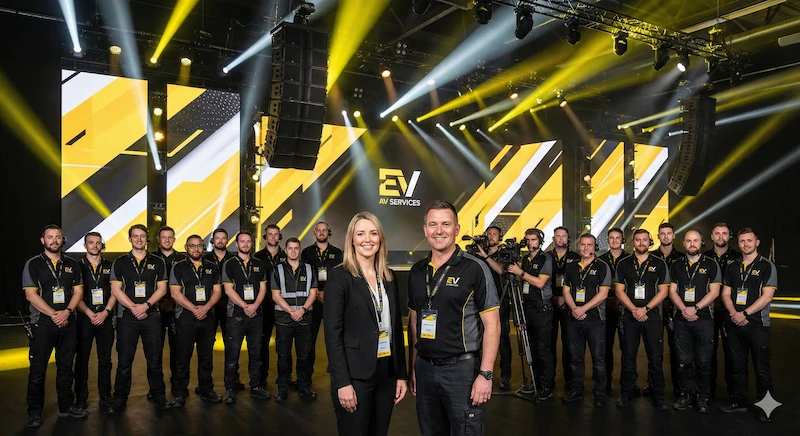
This is where the choice of technology partner becomes strategic. You are not renting speakers; you are taking out insurance against chaos. Professionals like the team at Edgar Vasquez Audiovisual Services understand that their real job is not only to make it look and sound good, but to manage the invisibility of error. Their approach is based on prevention: checking the venue, coordinating frequencies and having that extra cable that no one thought would be needed, but that ends up saving the day.
Conclusion
Organizing a congress involves managing hundreds of uncontrollable variables. Technology should not be one of them. By demanding redundancies in video, audio, power and connectivity, you are buying the most valuable asset in event management: certainty.
The next time you review a budget and see a line item for“backup equipment,” don’t look at it as an extra expense. Look at it and smile, because it’s a guarantee that no matter what happens, the show will go on and you’ll get the applause, not the complaints.