Have you ever wondered why a TV broadcast never “crashes” or pixelates, while your corporate video calls often suffer outages?
The short answer is: dedicated bandwidth and professional hardware. The long answer is what we are going to unpack in this article.
In today’s corporate environment, there is a dangerous confusion. Many managers believe that streaming their AGM is the same as opening a Zoom room. However, in our experience managing critical live events in Barcelona, we know that confusing a “videoconference” with a “broadcast production” is the perfect recipe for an image disaster.
It is not the same for 5 people to see you as for 500 people to see you. The technical architecture changes radically.
If you are responsible for organizing your company’s next hybrid event, you need to understand how the “magic” really works behind the scenes to demand quality and safety.
1. The Signal Flow: From the Camera to the World
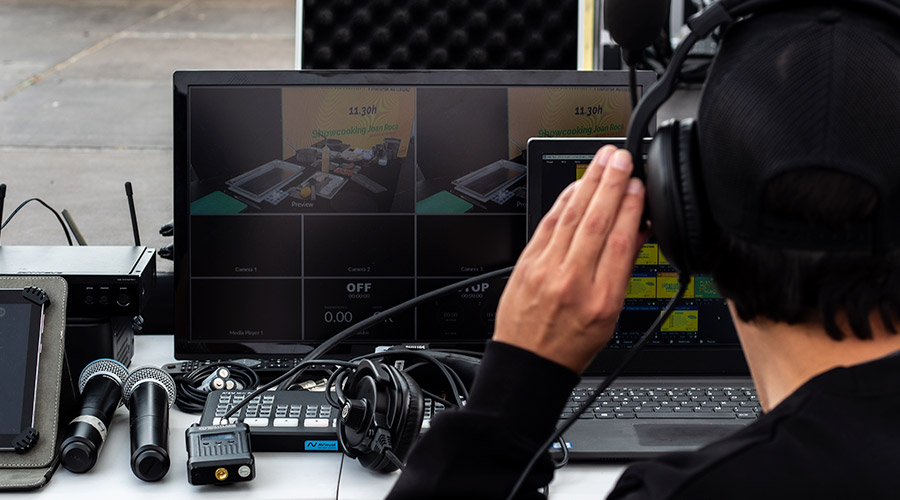
To understand how professional streaming works, it is necessary to visualize the journey the data takes. Unlike a USB webcam connected to a laptop (which depends on the CPU of that computer), a professional setup divides the work into stages to ensure stability:
Capture (The Source): We use professional video cameras (SDI/HDMI) and high-end microphones. This is where the image and sound quality is born.
Mixing (The Director): All the signals (cameras, PowerPoint presentations, videos) arrive at a video mixer. This is where a technician decides what is seen at each moment, achieving that dynamic television finish.
Coding (The Heart): This is the key. The mixed signal is passed to a dedicated hardware Encoder. This device compresses the video to send it to the Internet efficiently without losing quality.
Distribution (CDN): The signal is sent to a global server (YouTube, Vimeo, AWS) that replicates it so that thousands of people can watch it simultaneously without collapsing your connection.
2. Audio: 50% (or more) of Success
We can tolerate a slightly blurry image, but no one puts up with audio that cuts out or sounds tinny for more than 30 seconds.
In a live event, sound travels through the air. In a streaming event, the sound must be captured, processed and perfectly synchronized with the image (lip-sync).
“We recall a critical results presentation where, in haste, it was decided to rely on the laptop’s built-in microphone. Being omnidirectional, the equipment picked up more of the air-conditioning noise and the room’s echo (reverb) than the manager’s own voice. The result? Instead of discussing annual strategy, the chat was filled with ‘can’t hear well’ messages, and much of the audience tuned out before reaching conclusions.”
Therefore, our technical protocol always isolates the streaming audio mix from the room audio mix (PA). What the on-site attendees hear is not the same as what the online users must receive in order to hear it clearly in their headphones.
3. Redundancy: Your Life Insurance
What happens if the Internet goes down? In a home video call, it cuts out and you wait. At a high-level corporate event, that’s a reputation crisis.
This is where the concept of Armored Streaming comes in.
To guarantee broadcasting, we professionals do not rely on a single card. We implement bonding systems, adding, for example, the venue’s fiber optic + our own backup 4G/5G connections. If one line fails, the other takes over instantly without the viewer noticing.
4. Key Differences: Meeting vs. Broadcast Event
To clarify concepts, we have prepared this quick comparison:
Interaction: Zoom/Teams are for dialogue (everyone talks). A Streaming Broadcast is for communicating (one to many), with maximum quality.
Control: In a meeting, anyone can “unmute” their mic by mistake. In a professional production, the control is total and absolute by the technical team.
Aesthetics: Professional streaming allows for corporate lettering (speakers’ names, logos, flies), customized backgrounds and smooth transition between speakers and slides.
5. Why you need a Partner, not just a Platform
Understanding the theory is the first step. But executing it requires specific hardware (cameras, encoders, capture cards, sound tables) and, above all, qualified personnel to monitor the signal second by second.
At Edgar Vasquez Audiovisual Services we understand that when hiring a corporate live streaming services you are not only renting equipment. You are delegating technical stress management. Your team focuses on the content of the message and we make sure it reaches New York, Madrid or London with impeccable quality.
In conclusion:
Streaming corporate events is not magic, it is applied audiovisual engineering. It requires planning, dedicated equipment and security protocols that a home solution simply cannot offer.
Risking your brand’s image to save on the technical side is usually very expensive. The peace of mind of knowing that there is a human team monitoring every data packet that comes out of your event is priceless.
Do you want to take your digital events to the broadcast level?
Stop worrying about bandwidth and focus on your audience. Consult with our streaming experts and let’s design together a fail-safe technical architecture for your next broadcast.