Have you ever felt that comparing three technical quotations is like trying to read a language you don’t master? You have three spreadsheets, three very different final prices and only one responsibility: to make your company’s event perfect.
It is tempting to go straight to the bottom right cell of Excel and choose the lowest figure. However, in the history of Edgar Vasquez Audiovisual Services managing corporate events in Barcelona, we have found that this decision, seemingly logical from a financial point of view, becomes the marketing department’s nightmare on the day of the event.
A microphone that fails in the middle of the CEO’s speech or a screen that does not have sufficient resolution to display financial data are not “bad luck”; they are the direct consequence of what was cut in the budget. Technical quality is not improvised, it is paid for.
That’s why in this article we want to teach you how to read the technical “fine print”. We will break down what you are really paying when you hire a professional partner and why the price differences often hide abysses in the security of your event.
But before you sign that financial proposal, there are critical variables about staffing and timing that you need to know to protect your reputation.
1. Invisible Engineering: What happens before the event.
A common mistake when evaluating proposals is to think that you are only paying for the rental of a few speakers or screens for a few hours. Nothing could be further from the truth. When we analyze a project, the real work begins weeks before.
In a comprehensive proposal, a fundamental part is pre-production. This includes technical visits (Site Inspection) to measure the space, the design of CAD drawings to ensure that everything fits and coordination with the venue.
If a quote is suspiciously low, check to see if it includes these engineering hours. Without this advance planning, the day of set-up becomes a minefield of unforeseen events that end up costing much more money to resolve in a hurry. We prefer to invest hours in the office to ensure minutes of perfection on stage.
2. Technical Personnel: Labor or Qualified Engineers?
Herein lies one of the biggest cost differences and, at the same time, the biggest risk factor. On paper, the concept may simply say “Sound Technician”. But who is that person?
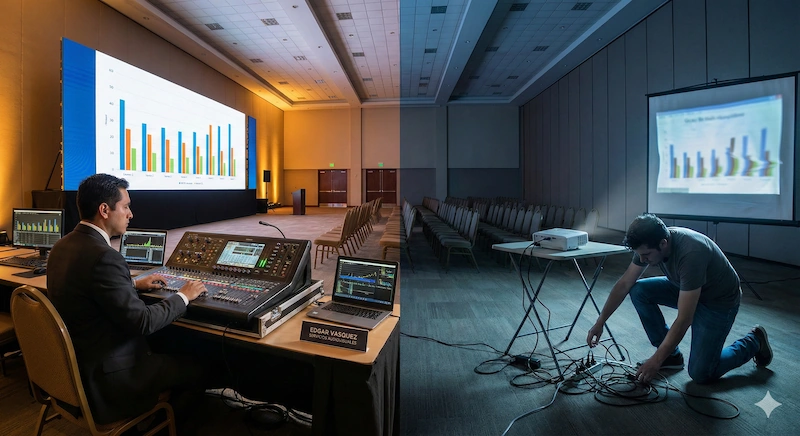
In the “low cost” sector, that figure is usually a generalist who transports, assembles and operates, often without specific certification for each piece of equipment. In a corporate environment, this is unacceptable.
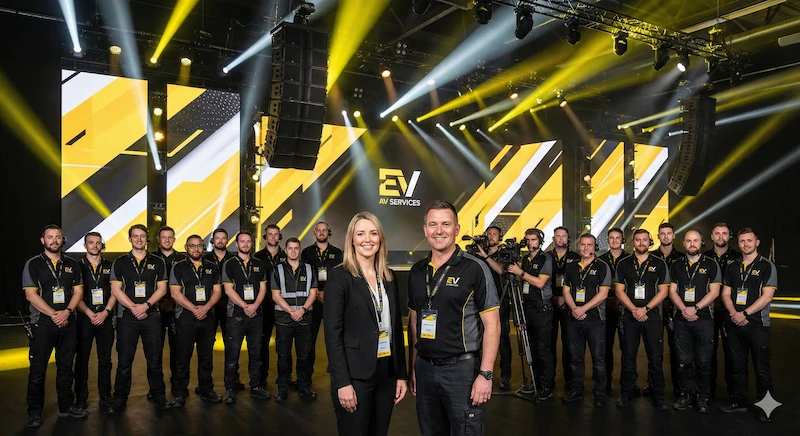
Our budgets reflect the cost of specialized personnel: a video engineer to manage content, a sound technician for room equalization and a Project Manager to coordinate the team.
When comparing proposals, don’t just look at the number of technicians, look at their qualifications. A event av service ensures that if a complex problem arises, the person in charge has the technical expertise to solve it in seconds, not minutes.
3. Hardware: Reliability vs. Basic Functionality
“3×2 meter LED screen”. That description can appear in two quotations with a price difference of 40%. What’s the catch? Reliability and picture quality.
There are entry-level devices on the market, prone to overheating and with an insufficient resolution (Pixel Pitch) for the proximity of a meeting room. We rely on reference brands and equipment that has been meticulously checked before leaving the warehouse.
In addition, a professional proposal always includes redundancy (backup). What happens if a computer fails? In our budgets, security is included: we have backup systems ready to go into action. This peace of mind comes at a cost, but it guarantees that your event will be shielded from technological failures.
4. The Time Variable: Assembly and Testing
Timeliness at a corporate event is non-negotiable. However, many suppliers adjust their costs by reducing set-up and staffing hours. This forces technicians to work in a hurry, increasing the risk of errors and accidents.
We plan the timing realistically and safely. This means arriving early enough to perform flawless assembly, conceal wiring (corporate aesthetics) and, most importantly, perform thorough system testing.
If a proposal offers to set up an hour before the start of the event to save on staffing costs, be wary. The testing time is the life insurance of your event. It is the time when we adjust the lighting, test the microphones with the speakers and ensure that the content is launched smoothly.
“A few months ago, we coincided in a large congress where we managed the adjoining rooms. The company in charge of the main stage, hired under a premise of ‘express assembly’ and low cost, arrived with just enough time and no margin to test the video signal.
Five minutes before the keynote address, their projection system failed and they had no contingency plan. The organization panicked. We had to intervene urgently, handing over one of our backup video mixers and rewiring its signal in record time to save the CEO’s presentation. That extreme stress situation, which put the brand’s reputation at risk in front of 300 attendees, would have been avoided simply with a real hour of testing and a technical team that wasn’t working against the clock.”
5. Risk Management and Insurance
Finally, there is a cost that nobody wants to see but that protects your company: legality. Operating heavy and electrical equipment in hotels or offices requires updated Civil Liability (CR) insurance and personnel registered with the Social Security and fully trained in Occupational Risk Prevention (ORP).
Overpriced proposals often cut into this security bureaucracy. As a client, you are co-responsible for what happens at your event. Working with an agency that rigorously complies with regulations is not an extra expense, it is a barrier to legal protection for your brand.
Conclusion: The value of sleeping peacefully
As we have broken down, the difference between two final figures in an Excel is not arbitrary. It is the distance between a generic, unsupported team and a planned technical solution, with expert staff and top-of-the-line equipment.
We understand that budget is important, but in the B2B environment, cheap is expensive in the form of reputation. What you’re really hiring is not just spotlights and speakers, it’s the certainty that everything will work perfectly when the lights come on.
Are you planning your next corporate event and need clarity?
Stop guessing what each line of your Excel includes. Request a technical consultancy here and we will design a transparent, detailed and optimized proposal for your company’s success.