Imagine the exact moment when your congress ends: the lights go down softly, the closing music enters at the precise second and the attendees burst into applause. That feeling of fluidity and harmony is no coincidence; it is the result of a perfectly oiled human machinery where each piece knows exactly what function it fulfills.
The success of a memorable staging depends not only on having the best technology, but also on the precision with which the roles are executed in the production of an event.
In order to achieve this level of excellence, it is essential to have integral audiovisual solutions not only equipment, but also a hierarchical professional structure.
Below, we will discuss how we organize this human structure to ensure that your next convention in Barcelona is, quite simply, perfect.
The management triangle: Client vs. Producer
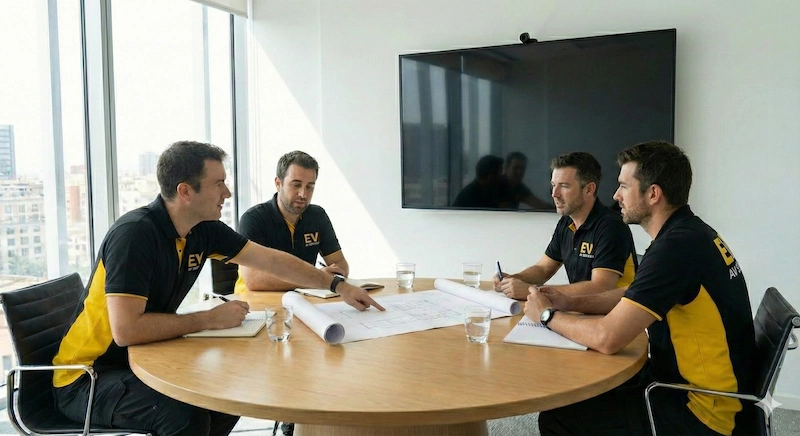
For a flawless execution, we must first separate strategy from tactics. In any professional setup, we identify three figures that must work in coordination:
The Customer (Marketing/CEO): Defines the objective and the message.
The Event Manager: Coordinates the global logistics (venue, catering, agenda).
The Audiovisual Partner: Executes the technical reality.
I well remember the case of a Marketing Director who came to us after a traumatic experience. At his previous event, in order to save costs, he hired a “one-man band” technician who promised to take care of everything: sound, video and lights at the same time.
The result was catastrophic: while the technician was trying to fix a beeping microphone, he forgot to launch the CEO’s corporate video. The stress in the room could be cut with a knife.
When we sat down with him to plan his next congress, we explained to him that hiring an event production professional event production company means deploying specialist roles, not saturated generalists. He understood that peace of mind came at a price, and that price guaranteed that no one would improvise with his brand image. Since then, he has never taken another gamble.
The RACI Matrix applied to the event
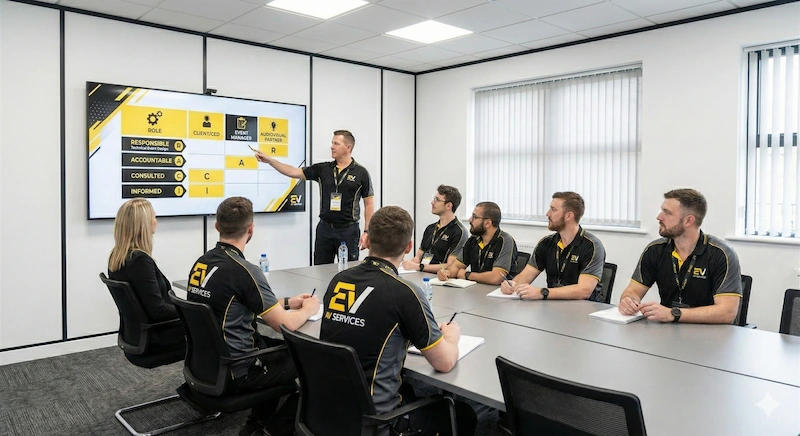
To avoid friction, we apply a philosophy similar to the RACI (Responsible, Accountable, Consulted, Informed) matrix. This is vital to correctly define the roles in the production of an event and ensure that each cable has a responsible person.
This matrix clarifies who is the “owner” of a task (Accountable) and who executes it (Responsible). In this way, we eliminate the responsibility gaps that often cause technical failures.
Below, we break down the technical hierarchy necessary for your peace of mind.
The Management Dome: Who conducts the orchestra?
Technical success begins long before the spotlight is turned on. These profiles translate the customer’s vision into reality:
Head of Production: The architect of the operation. His mission is to translate customer expectations into a viable technical plan, coordinating across all departments.
Project Manager: The executing arm. He oversees that the plan is followed to the millimeter and acts as your main interlocutor to solve incidents and manage changes.
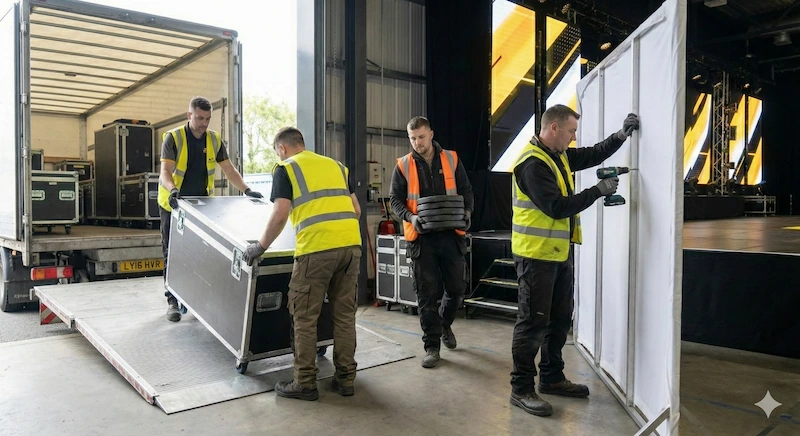
Crew Chief: The foreman in the field. He coordinates the technical staff during loading and assembly at the Barcelona sites, ensuring time and safety.
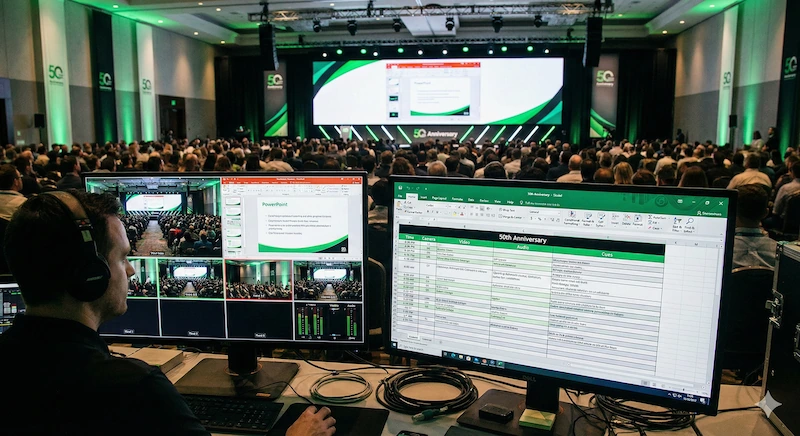
Show Caller (Ruler): The live voice of command. He/she sets the rhythm of the event by singing the cues of videos and lights, strictly following the technical schedule of the technical rundown of the corporate event.. Without him, synchronization is impossible.
Video Equipment: Visual Engineering
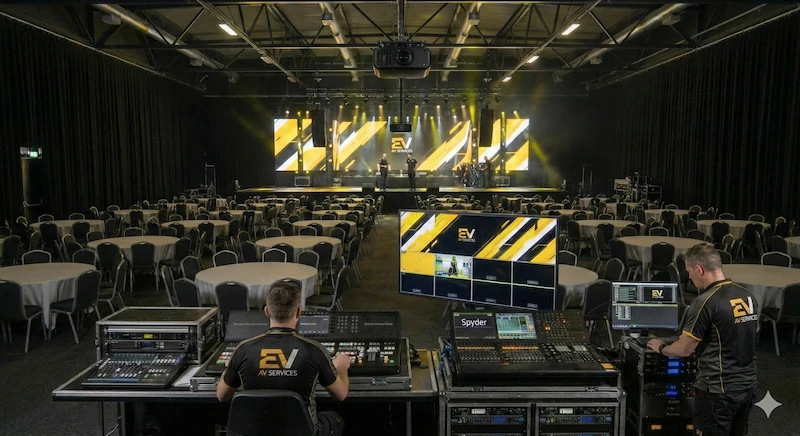
In today’s era, the screen is the protagonist. Defining these roles in the production of an event is critical, especially when we are managing LED video wall rental that can’t afford mistakes:
Graphics Operator: Responsible for everything that is “launched” on screen (PPT, videos, signage). Ensures that the formats are correct before going on air.
Spyder / Aquilon Operator: Manages high-performance video processors. Controls the composition of multiple windows (PiP) in complex video walls.
Projector Technician: Optical specialist. Aligns the projectors(blending) so that the image is geometrically perfect.
LED Screen Technician: LED architecture expert. He is in charge of the physical assembly and live maintenance to correct any signal failure instantly.
Video Technician: Field technician who installs and wires the entire video base infrastructure.
Hybrid Event and Streaming Roles
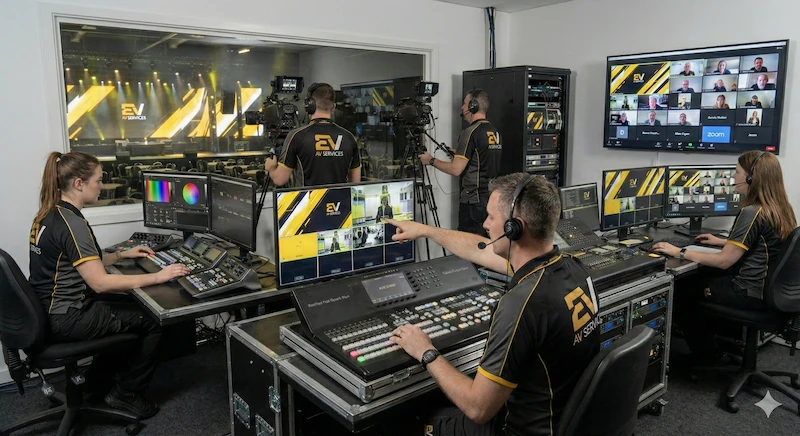
If the event is broadcast externally via a event live streaming services we need profiles to manage that window to the world:
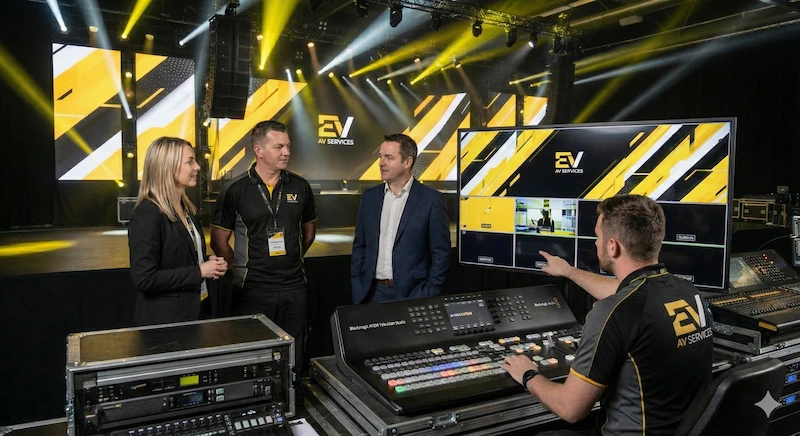
Camera Director (Director): The visual storyteller. Decides which camera is shown at any given moment and is responsible for the remote viewer’s experience.
Camera Operators: Operate the cameras following the director’s framing and movement instructions.
CCU Operator: Adjusts the colorimetry of the cameras in real time so that all shots have the same light and tone.
Call Center Operator: Remote connection manager. Receives the signal from the speakers via videoconference, checking its quality before going live.
Sound Equipment: The basis of communication
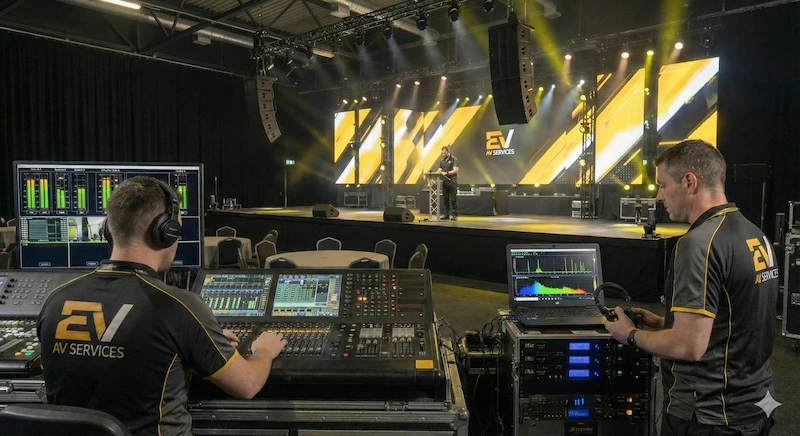
Sound is as important as it is delicate. A failure here breaks the message. To guarantee a event sound services, we assign dedicated technicians:
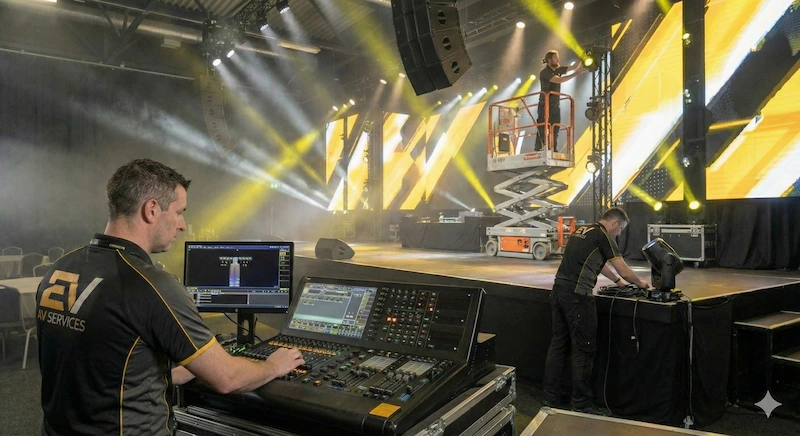
Sound Operator (PA/Broadcast Technician): Responsible for the final mix. Balances the volumes for the audience in the room and generates an independent mix for streaming.
RF System / Com Technician: The guardian of the frequencies. It coordinates the spectrum to avoid interference in wireless microphones and manages the technical intercommunication.
Sound Technician: Audio technical support. Responsible for micing the speakers and laying the necessary cabling.
Lighting and Atmosphere Equipment
The production technician is creatively responsible for conveying emotion. Lighting plays a fundamental psychological role in reinforcing the audiovisual branding of your event:
Lighting Operator: The light artist. Operates the console to create immersive environments and ensure that the lighting is suitable for video (avoiding harsh shadows on faces).
Lighting Technician: Assembles lights,trusses and performs the physical routing of the luminaires under supervision.
Other essential audiovisual professionals
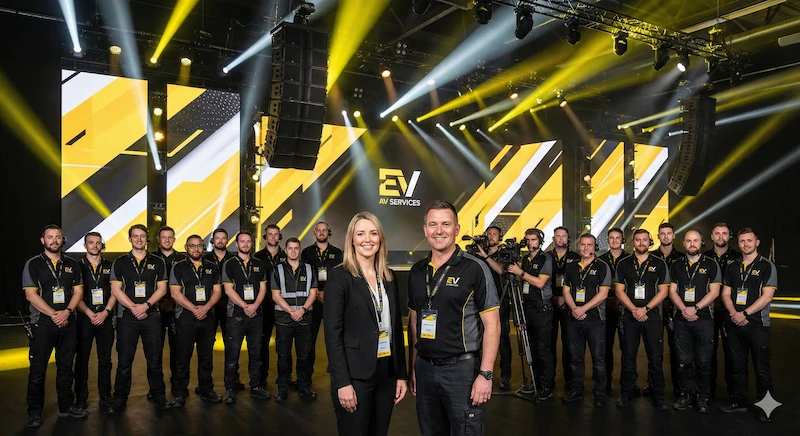
To complete these multidisciplinary teams at Edgar Vasquez Audiovisual Services we have the logistical muscle:
Deco (Scenography): Personnel in charge of non-technological visual elements: assembly of backdrops, integration of screens and aesthetic finishes.
Hands / Roadies: Vital support for loading, unloading and movement of heavy materials, speeding up the work of specialists.
In conclusion
Technology is important, but the people who operate it are more important. A clear definition of roles in the production of an event, structured under a clear matrix and a solid management triangle, is the foundation of any successful staging.
Leaving the technical hierarchy to chance – or in the hands of a single operator – is a risk your reputation cannot afford. Excellence in a city as competitive as Barcelona requires method, and method requires experts.
Do you have a complex event on the horizon? Don’t leave technical roles to the last day. Request here your technical consultancy and let us plan in advance the human structure that your project deserves.