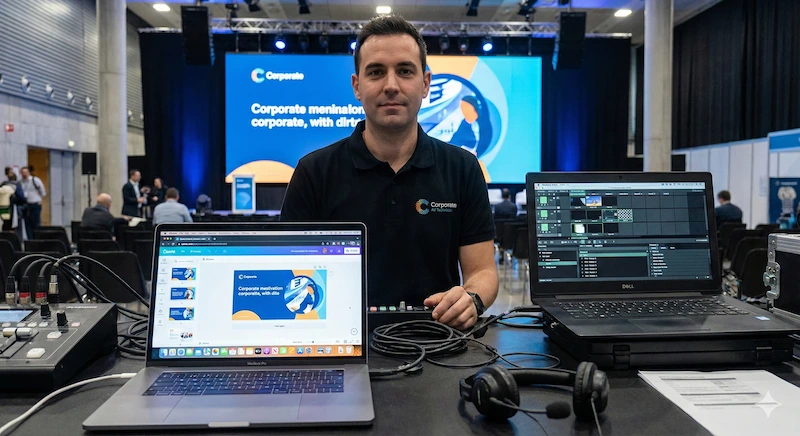
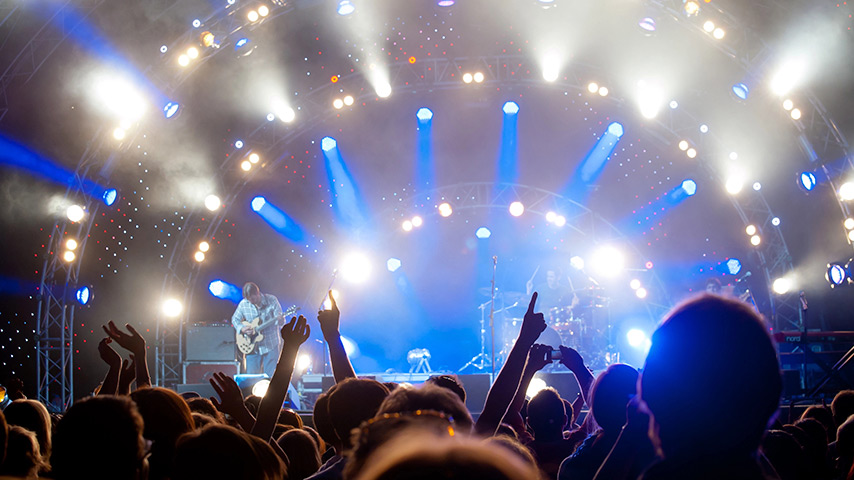
There is a magic moment in every corporate event: that instant when the room lights go down, the main screen lights up with absolute clarity and your company’s message reaches the audience without barriers or interruptions.
That sense of fluidity and professionalism is what we are all looking for. When technology works in perfect harmony, it ceases to be a concern and becomes your brand’s best ally, enhancing the experience of each attendee.
However, achieving that “magic” is not a matter of chance, but of precise orchestration between your devices and the space. In this article, we’ll share how to ensure equipment compatibility in venues through expert planning, ensuring that on the day of the event you only have to worry about getting the applause.
The technical reality of corporate spaces
Often, when renting a modern room, we assume that “everything will connect to everything”. The reality is that audiovisual standards are advancing faster than the fixed infrastructures of hotels and auditoriums..
This is where our team adds value in advance. We perform audio visual event solutions in Barcelona that function as a secure bridge between your state-of-the-art technology and the venue’s facilities, ensuring that the signal flows clearly.
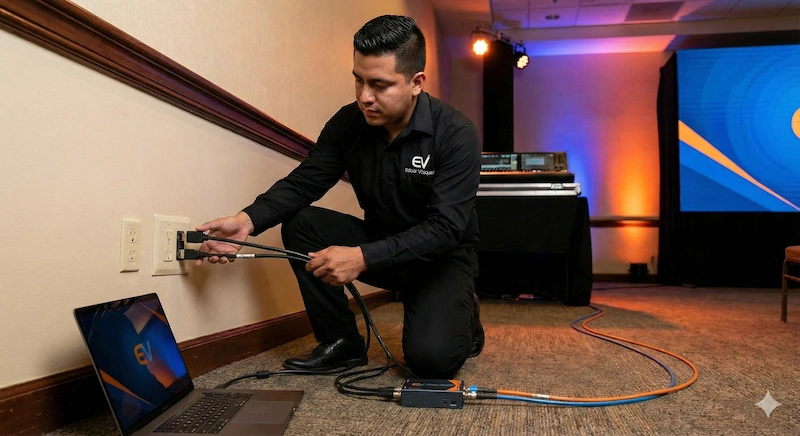
At Edgar Vasquez Audiovisual Services we know that the client’s peace of mind comes from the previous audit.. Our methodology leaves no room for improvisation; we check every port and every cable before the first guest arrives.
The video challenge: Distances and cabling options
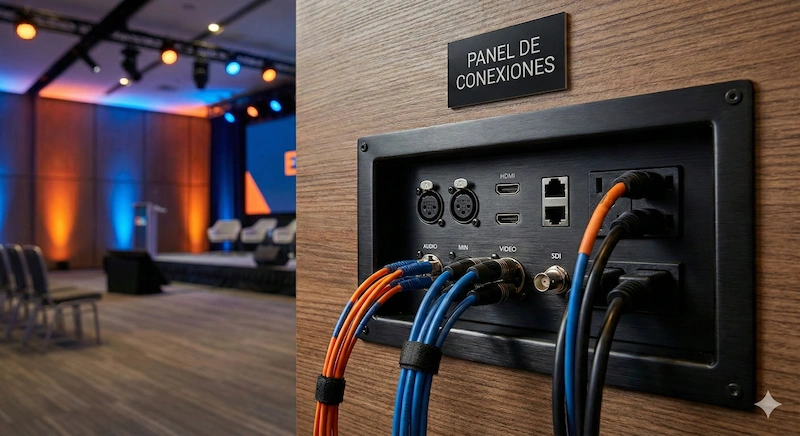
One of the critical points in the compatibility of equipment in venues is the management of the video signal. It is a technical detail that surprises even many experienced Event Managers: the domestic HDMI cable has a physical signal transmission limit of 10 to 15 meters.
Exceeding this distance without reinforcement causes flickering, digital “snow” or total loss of image.. Since in many events the control desk is at the back of the room (away from the lectern), connecting directly is unfeasible.
Our professional solutions for long distances:
SDI conversion: We transform the signal to BNC coaxial cable, allowing runs of hundreds of meters in a shielded way. shielded and robust, ideal for harsh environments..
HDMI Extenders (via CAT6): We use high-end network infrastructure to transport the video signal point-to-point without quality loss.
Fiber Optic HDMI: A very high quality solution that allows long distances while maintaining the native HDMI connector. However, we use it with caution: it is a delicate and expensive technology that requires expert handling, as an accidental step on it or excessive bending can render the cable unusable..
Wireless and Collaborative Systems: For clean stages or dynamic presentations, we integrate radio frequency links (such as the Teradek Bolt 4K) or presentation systems such as Barco ClickSharewhich allow content to be launched without connecting physical cables to the computer..
Resolutions and Aspect Ratios: Perfect Picture
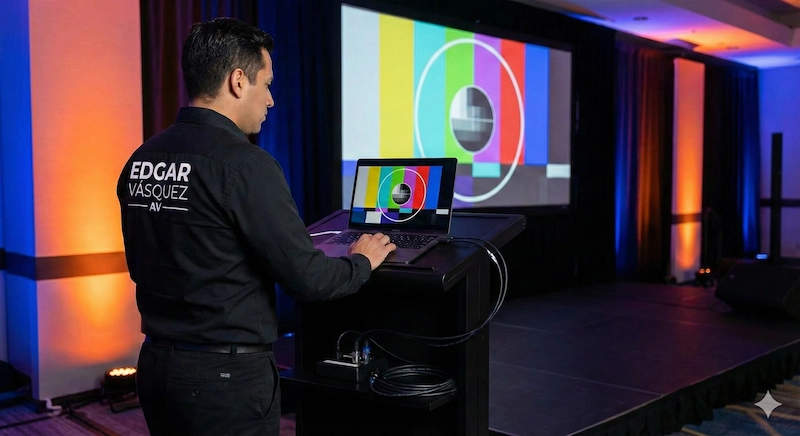
Another vital aspect is the aspect ratio (Aspect Ratio). You have probably attended conferences in Barcelona where the company logo looks “stretched” or black bars appear. This happens because of a disconnection between the configuration of the laptop (16:9 or 16:10) and that of the projector or LED screen..
Our technical solution: We use professional videoscalers. These devices process the image and adjust it mathematically pixel by pixel so that it fits perfectly. flawlessly to on the display medium..
Audio Connectivity: Embedded or Independent?
The picture is crucial, but the sound conveys the message. Today, it is standard to send audio embedded within the digital HDMI signal itself. It is convenient, but in large events it can limit the control of the mix..
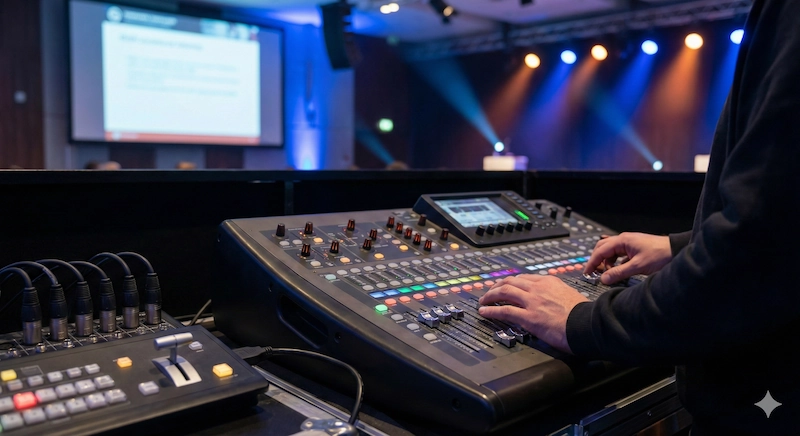
In our audiovisual company, we prefer to separate signals when necessary. We extract the audio to process it independently on our digital desks, ensuring perfect levels and dedicated equalization. This way, we avoid distracting volume jumps for the audience.
The importance of the "Site Inspection" (Technical Visit)
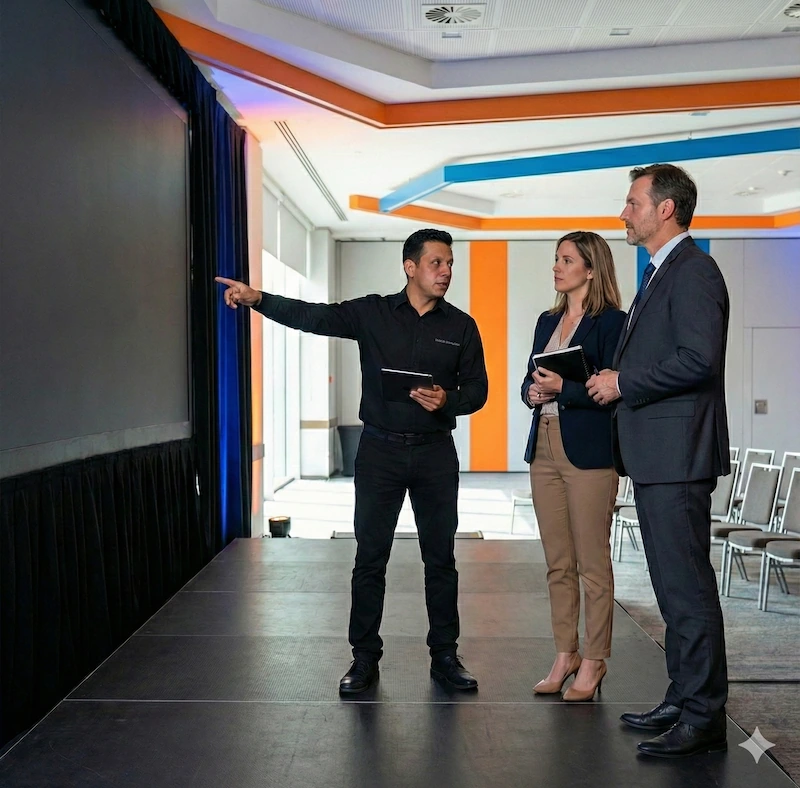
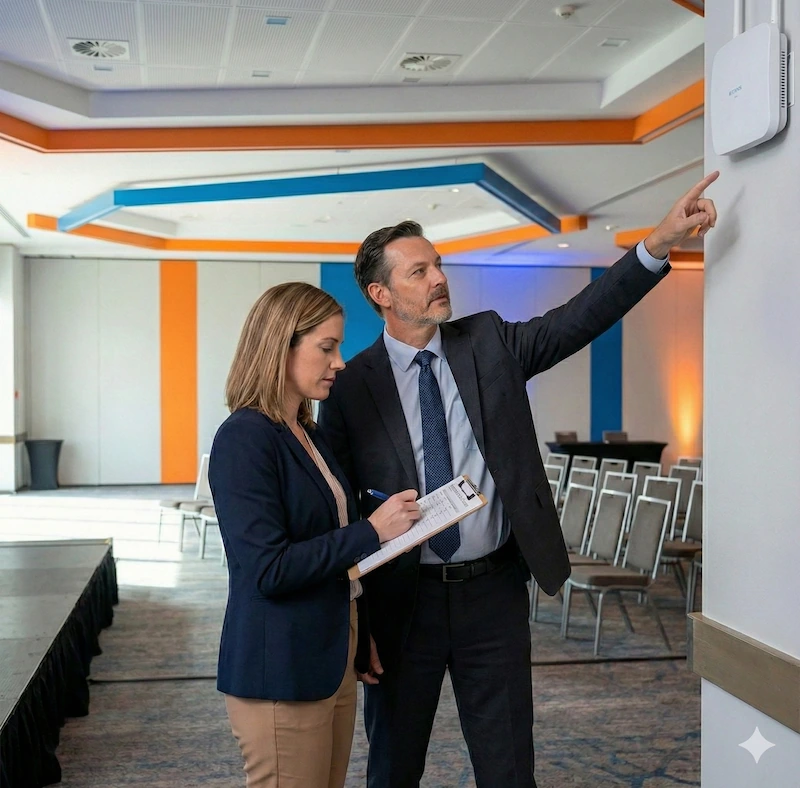
In order to ensure equipment compatibility in venues, the most the most powerful tool is not a device, but a process: the technical visit or Site Inspection. Site Inspection.
Before moving a single loudspeaker, our technical team travels to the event location in or around Barcelona. There we test for incompatibilities weeks before the key date.
[REAL ANECDOTE]: Event in the center of Barcelona
I remember a technical visit to a beautiful historic building in the Gothic Quarter. Architecturally it was a gem, but technically a challenge: the stone walls blocked 4G and the room lighting was too dim and yellowish. Thanks to the pre-visit, we installed dedicated fiber optics for streaming and designed scenic lighting with corporate LED spotlights, bathing the stone walls in the client’s branded blue color. We transformed a “dreary” environment into a vibrant brand experience.
The updated Technical Rider: Questions that save events
If you’re going to request a quote or coordinate with a space, make sure you speak the same language. Here are the key questions to ask about equipment and infrastructure.:
About Internet Connectivity:
Connection type: Is it dedicated fiber optic cable (Hardline) or just shared Wi-Fi (Wi-Fi is never enough for professional streaming)? .
Stability and Speed: Is a symmetrical line (same upstream and downstream speed) guaranteed? What is the actual bandwidth available in the room?
Location: Where are the network ports, do they reach the control area or do they stay on the stage?
About the Location of the Technical Control:
Position: Where will we be able to locate the technical control (FOH) and will we have a direct view of the stage?
Supplies: Does that area have separate outlets and close access to network points, or will we need to pull extra meters of wiring through the middle of the room?
About Room Infrastructure:
Electrical power: Are there independent phases for audiovisual or will we share the line with kitchens and catering? (High risk of power failure). .
Lighting control: Is it digital or analog? Can we control the lights by zones (e.g.: lower the screen light but keep light on the audience)?.
Projection and Audio: Is the projector laser and current? Do the speakers have dynamic range for music or are they for voice only?.
Staffing: Is there a face-to-face room technician for emergencies?.
Conclusion: Planning is your best investment
As we have discussed, equipment compatibility in venues is not a minor detail; it is the backbone of your event’s reliability. Leaving these connections to chance or blindly relying on what the space “claims to have” is an unnecessary risk..
Technology must be invisible. When everything is working properly, no one notices the fiber optics, the extenders or the climbers; they only see your message and your brand shining in Barcelona.
Bottom line: Ensuring that your presentation looks and sounds perfect depends on professional technical integration that audits and resolves incompatibilities before they occur.
The Bridge: However, having the right equipment is only half of the equation. The other half is having expert technicians on-site who know how to configure those systems to run like Swiss clockwork..
Want total security for your next event? Stay ahead of the unexpected. Request here your technical consultancy and let us plan the perfect audiovisual integration for your venue..