
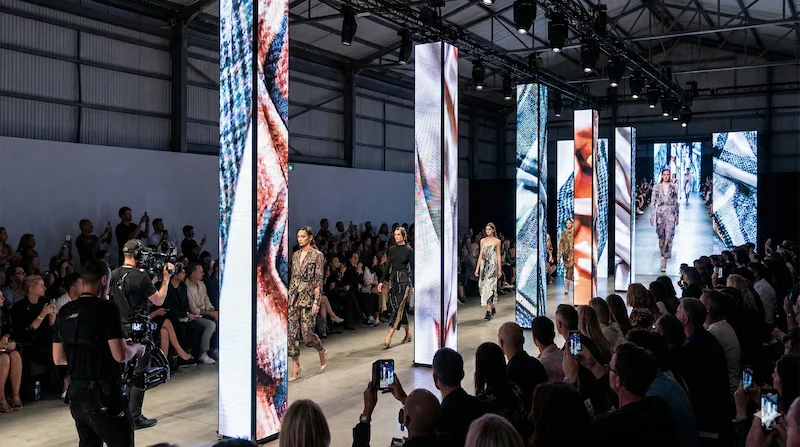
Have you ever calculated how much visual impact a couture collection loses when projected on a horizontal format that drastically cuts and shrinks the human silhouette? In our history of managing technical production in the corporate and fashion sectors, we have seen first-hand that set design is still dangerously anchored to television standards of the past, ignoring the enormous potential of vertical LED screens.
Today, a fashion show or showroom presentation demands a truly immersive look & feel, where technology embraces the drape of the fabric rather than competing against it.
The good news for project managers is that transforming the stage design doesn’t require an exponential increase in the event budget. It requires, above all, impeccable technical planning and an audiovisual partner who fully understands the venue’s physical limitations.
But before you completely rewrite your next technical rider, there is a critical factor about the resolution and physics of the spaces that will determine the success or failure of your event when it comes to implementing atypical formats.
The 16:9 paradigm: Why limit creativity?
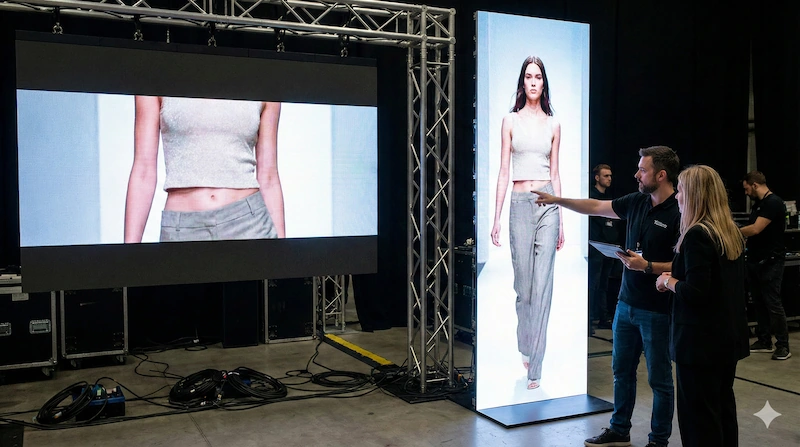
For decades, the MICE industry has standardized on the 16:9 format in almost any audiovisual configuration. It is the safe, predictable and most common option found in conventional auditoriums. However, in the demanding fashion ecosystem, conventional safety often translates into visual monotony and loss of detail.
The silhouette of a model walking down the runway is, by geometric definition, a vertical line. Forcing that image into a landscape-oriented rectangle compels filmmakers to make technical decisions that directly undermine the audience’s engagement: either they shoot close-ups that hide the shoes, or they show a wide shot that leaves huge black spaces on either side of the figure.
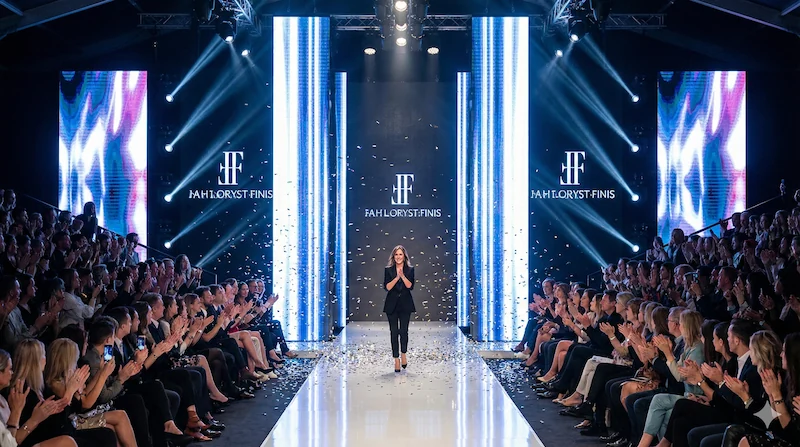
To resolve this aesthetic imbalance at its root, the integration of giant LED screens for events in Barcelona tailored to atypical aspect ratios is no longer just a whim. Today, the use of vertical LED screens is an absolute narrative necessity. This configuration respects the natural proportions of the human figure and amplifies the impact of the design.
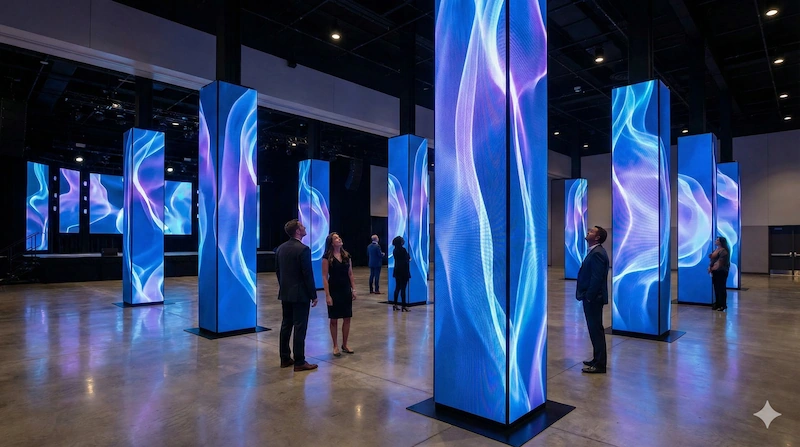
The anatomy of space: Totems and immersive columns
Designing a fashion event requires thinking of the runway not just as a flat stage, but as a fully three-dimensional canvas. This is exactly where the Comprehensive technical production must take the lead.
Replacing a single backdrop screen with an array of vertical LED screens strategically placed throughout the venue completely alters the perception of depth.
This fragmented layout allows the visual content to envelop the audience. The video is no longer a static element; it interacts directly with the models as they walk the runway.
Based on our experience at Edgar Vasquez Audiovisual Services we have shown that when technology is seamlessly integrated with art direction, the physical hardware disappears, leaving only the pure visual experience.
From the initial kick-off phase onward, designing non-standard configurations requires our team to perform highly precise structural calculations of weights, anchors, and concealed wiring.
We understand that in a parade premiumWe understand that in a premium parade, a single exposed wire or misaligned panel completely destroys the magic of the environment and the perception of luxury.
Technical integration: The challenge of catwalk setup
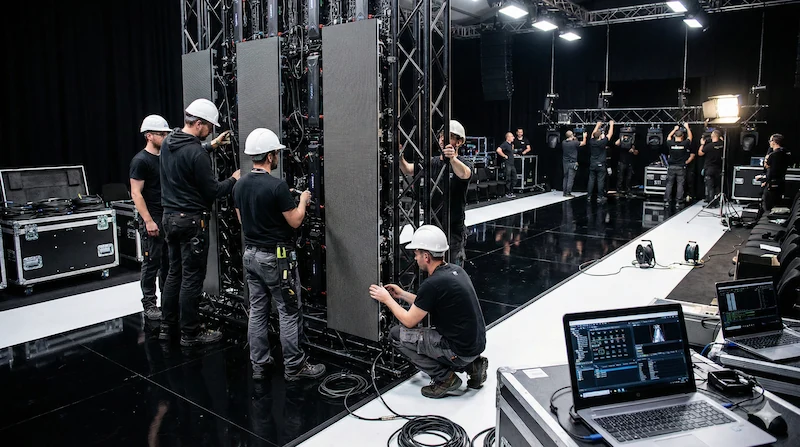
Changing the natural orientation of audiovisual equipment presents serious temporary engineering challenges. A traditional setup is usually quick and standardized, but configuring non-standard visual displays requires a professionally planned setup that is executed well in advance to ensure the system’s absolute stability.
The main challenge in these fashion settings is managing video resolution. When physically rotating the cabinets, our video technicians must map the signal from the processors in a 100% customized way. This is essential to ensure that native content plays smoothly, without distortion, strange scaling, or perceptible latency that could ruin the choreography. Entrusting this immense technical complexity to true experts is vital for your peace of mind.
Relying on comprehensive audiovisual solutions for global events ensures that our video equipment, stage lighting, and sound are all synchronized. This prevents catastrophic conflicts during dress rehearsals and guarantees that the run-of-show proceeds seamlessly.
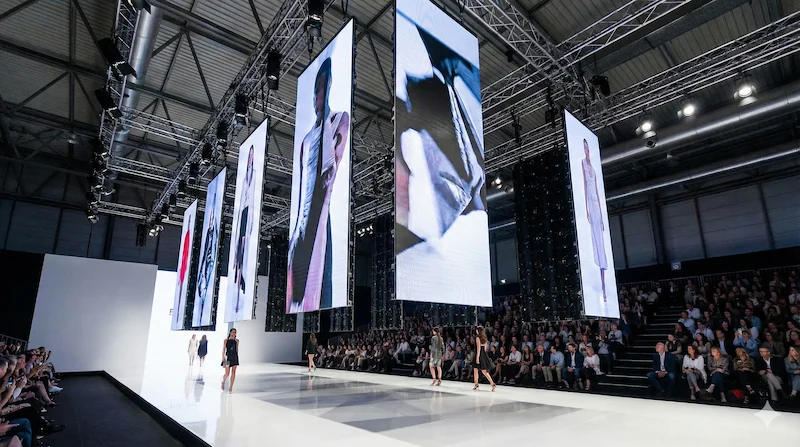
The challenge at the Fira de Barcelona: A success story
To understand the magnitude of proper technical planning, it is enough to observe the stress dynamics that are experienced at large trade fair sites.
During the last edition of the Barcelona Bridal Fashion Week, held at Fira de Barcelona (Gran Via), our team faced a critical logistical challenge that demonstrated the vital importance of on-site responsiveness.
Just 48 hours before the show began, the creative agency suddenly decided to narrow the main runway to add an extra row of seats in the VIP front row. This architectural change meant that the four 4-meter-high vertical LED screen blocks were dangerously encroaching on the runway intended for the models.
Instead of sacrificing the visual impact at exhibition venues by dismantling the structure, our technicians recalculated the structural loads on the fly. We decided to remove the floor bases (plinths) that were taking up usable space and opted to suspend the screens vertically using an advanced rigging system anchored to the truss motors on the ceiling.
We managed to make the enormous vertical LED screens levitate exactly 15 centimeters above the floor. This kept the visual immersion intact, completely cleared the catwalk, and allowed us to hide all the wiring overhead. The event was executed with pinpoint precision, proving that our planning and talented team are the true lifeline of the event.
Profitability and ROI: The impact on the digital ecosystem
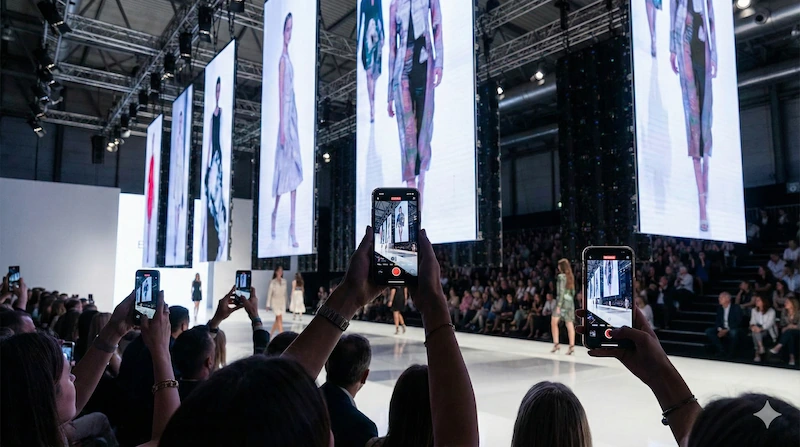
As an Event Prof, you know full well that the life cycle of a fashion show doesn’t end when the last model leaves the runway and the spotlights go out. These days, the ROI (Return on Investment) of a fashion event is measured, in large part, by how much it goes viral on social media and corporate channels.
This is where the use of vertical LED screens really shines and proves its absolute cost-effectiveness. The platforms that dominate today’s communication landscape (Instagram Reels, TikTok, YouTube Shorts) natively display content in a 9:16 aspect ratio.
When your event’s physical set design is already built and planned with this format in mind, the content that attendees record with their cell phones fits perfectly on end-users’ screens. This leads to a dramatic increase in your brand’s organic engagement, as the shared content is aesthetically superior and properly framed by default.
Minimizing risks: Contingency and Site Inspection
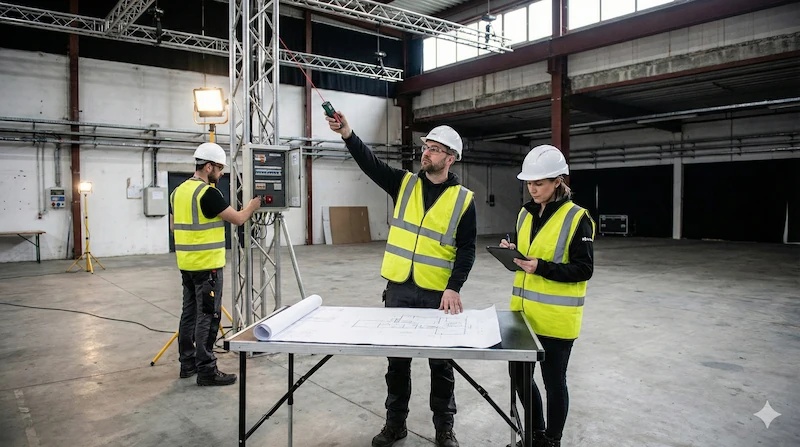
Innovating in the way a fashion collection is presented must not, under any circumstances, compromise the stability and technical safety of the event. Every truly ambitious audiovisual project begins weeks before the key date with exhaustive technical venue audits conducted by our professionals.
During this critical technical visit to the venue, we thoroughly evaluated the electrical outlets, the structural integrity of the ceiling, and any logistical bottlenecks.
When planning the installation of large-format vertical LED screens, we must ensure the stability of the bases against vibrations and calculate the anchor points in strict accordance with certified standards.
That is why it is important to have the support of our team at Edgar Vasquez Audiovisual Services eliminates any friction between the creative agency’s ambition and the physical feasibility of the setup right from the start.
Our approach always focuses on providing you with a secure work environment, with on-site support teams, ensuring that cutting-edge designs are executed with unwavering safety.
The importance of Pixel Pitch in immersive environments
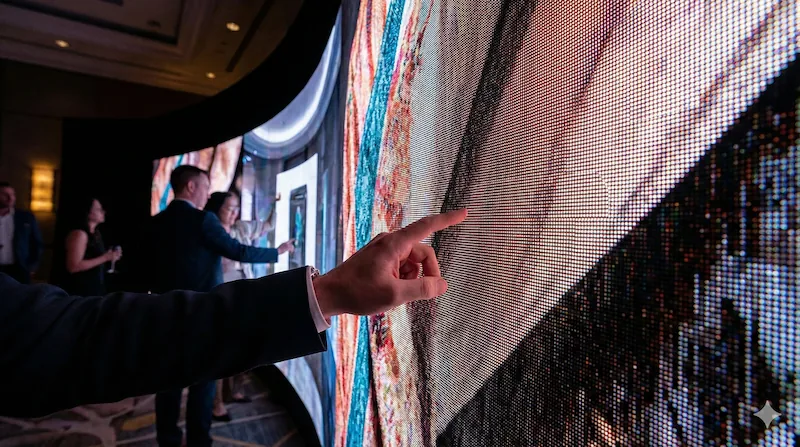
At a haute couture fashion show, the front-row audience (VIP guests, the fashion press, and buyers) sits just a few meters from the runway. At such close viewing distances, the quality of the light-emitting diode leaves no room for technical compromises or cutbacks.
Using LED modules specifically designed for indoor use with an extremely small pixel pitch is non-negotiable. If this distance is too large, your audience will notice the distracting grid pattern on the screen instead of appreciating the intricate details of the garment, breaking the immersion and undermining your branding efforts.
In addition, color processing must be of premium quality. In our setups, we ensure that the exact shades of the fabrics are reproduced with millimeter precision. A bridal white on the physical runway will match exactly the white projected on the backdrop screens, without any blue or green tints that could ruin the official photographs.
In conclusion: Is it worth the technological investment?
Visual innovation always demands enormous technical precision.
Setting up an unconventional stage design using vertical LED screens is undoubtedly a major logistical challenge, but its benefits more than justify every minute we devote to the preliminary technical design. When the audiovisual format aligns with the nature of the product, the overall perception of quality skyrockets.
- Enhanced silhouette: Natural and geometric harmony with the human form.
- Native 9:16 aspect ratios: Content ready to go viral on Reels and TikTok.
- Scenic Depth: Say Goodbye to the Monotony of Flat Backgrounds.
- Total Immersion: The audience is visually enveloped by technology.
- Premium positioning: A high-end, cutting-edge brand image.
- Zero risk: Certified design and 100% concealed wiring.
- Smooth Run of Show: Impeccable execution delegated to true experts.